10 Years on Victoria StreetSave up to $1,000 on your kitchen or bath. Print your coupon and bring it in.Get the coupon
✕
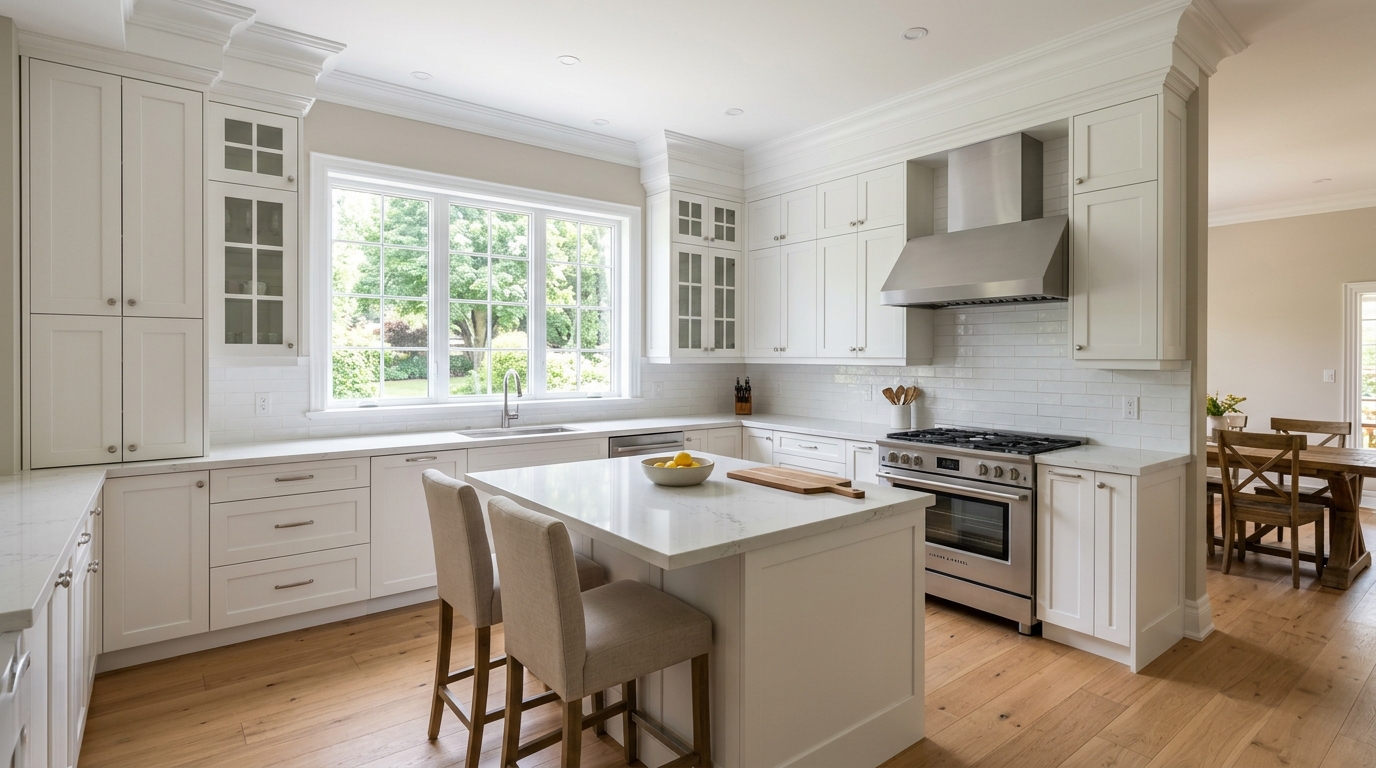
If your kitchen cabinets are looking tired but the layout still works, you have two main paths: reface them (keep the boxes, replace the doors and exterior surfaces) or replace them (tear out the old cabinets and install new ones). Refacing typically costs $4,000 to $12,000 for an average Kitchener kitchen, while replacing runs $8,000 to $25,000 or more — so refacing saves roughly 30% to 50%.
But cost isn’t the whole story. Refacing only makes sense when your existing cabinet boxes are in good structural shape, and that’s a bigger “if” than most homeowners realize. This guide breaks down both options honestly so you can make the right call for your kitchen and your budget.
Cabinet refacing means keeping your existing cabinet boxes in place and replacing everything you see on the outside. A typical refacing project includes:
What stays the same is the cabinet boxes themselves — and your kitchen layout. Refacing doesn’t move walls, change cabinet sizes, or add storage. It’s a cosmetic transformation, not a structural one.
Replacing means removing your old cabinets entirely and installing new ones. Because everything comes out, you have complete freedom to change the layout, adjust cabinet sizes, add an island, build in a pantry, and choose better-quality construction. It’s more disruptive and more expensive, but it’s also the only option that lets you fundamentally change how your kitchen works.
Here’s what each option typically costs for a standard 10' × 10' kitchen in the Kitchener-Waterloo area in 2026:
Refacing delivers a large share of the visual impact of new cabinets at a fraction of the cost — but only if the underlying boxes are worth keeping. That qualifier is everything, and it’s where we see homeowners make expensive mistakes.
Refacing is a smart choice when all of the following are true:
Replacing is the right call — and refacing is often a waste of money — when any of these apply:
Here’s the honest math: refacing a poor-quality box might save you money today, but if those boxes fail in five years, you’ll pay for the kitchen twice. If your existing cabinets are cheap particleboard, replacing them with solid maple doors on a sturdy plywood box is almost always the better long-term value.
If your doors are solid wood and in good shape and you simply want a different colour, repainting or refinishing can be even cheaper than refacing — typically $2,000 to $5,000 professionally done. It won’t change the door style, but for a quality existing kitchen that just needs a colour update, it’s worth considering. Our guide to painted vs. stained cabinets covers the trade-offs.
Start by honestly assessing your existing cabinets. Open the doors, pull out the drawers, and look at the boxes. Are they solid wood or plywood, square and sturdy? Or are they sagging, swollen particleboard? Then ask whether the layout truly works for how you cook and live. If the boxes are good and the layout works, reface. If either fails the test, replace.
At Kitchen & Bath World, we’ve built solid maple kitchens on Victoria Street for over ten years — solid maple doors and drawer fronts on a plywood box, with dovetail drawers on concealed undermount roll tracks and soft-close hinges — and we’ll give you a straight answer about whether your cabinets are worth refacing or whether replacement is the smarter investment. Every project is designed in 3D first, so you can see your new kitchen before any work begins.
Visit our showroom at 899 Victoria St N in Kitchener, or request a free estimate and we’ll help you choose the option that makes the most sense for your kitchen.
Answers to your renovation questions
Open the doors and inspect the boxes: solid wood or plywood that is square, sturdy, and free of water damage or sagging is worth refacing. If the boxes are swollen, delaminating particle board, refacing wastes money on a failing foundation. Also confirm the layout still works, since refacing can't move or resize anything. At Kitchen & Bath World we'll give you a straight answer in person. Explore replacement options on our kitchen cabinets page.
Refacing is usually done in a few days and your kitchen stays largely usable, while a full cabinet replacement typically takes a few weeks because of teardown, installation, and coordinating countertops. Replacing is more disruptive but it's the only path if you want to change layout, add storage, or upgrade construction. For how the wider project unfolds, see our kitchen renovation timeline guide.
Usually not. Putting new doors on failing particle board or MDF boxes means paying for a foundation that may swell and sag within a few years, so you end up buying the kitchen twice. If your existing boxes are low-quality engineered panel, replacing them with solid maple doors on a plywood box is almost always the better long-term value. Our solid maple vs. MDF guide explains why box material drives this decision.
Yes, if your doors are solid wood, in good shape, and you only want a colour change, repainting or refinishing runs about $2,000 to $5,000 professionally done, cheaper than refacing. It won't change the door style or layout, but for a quality existing kitchen it's a smart refresh. Our guide to painted vs. stained cabinets covers the trade-offs before you commit to a finish.
Refacing delivers strong ROI when the boxes are sound, giving a near-new look at a fraction of the cost, which is why it ranks among the highest-return kitchen upgrades. Replacing adds more value when it also fixes a bad layout or failing cabinets buyers would notice. In the Kitchener-Waterloo market, dated cabinetry is a major turnoff. See how cabinetry choices factor into your home value.
Replacing lets you change the layout entirely: move the sink, add an island, build a taller pantry, resize cabinets, and add pull-outs and deep drawers. Refacing keeps every cabinet exactly where it is and can't alter a single dimension. If your kitchen doesn't function well, replacing is the only real fix. Every replacement we do is designed in 3D first. For layout planning, read our kitchen layout guide.
Have more questions? We’re here to help.
Come see the cabinets and finishes in person at 899 Victoria St N, Kitchener — or fill out the form and our team will get back to you about your kitchen or bath project.