You can have the most beautiful cabinets and countertops money can buy, but if your kitchen layout doesn't work, you'll feel it every time you cook a meal. Layout is the foundation of a functional kitchen. It determines how efficiently you move between tasks, how much usable counter space you have, and whether the room feels comfortable or cramped.
Kitchen layout planning has evolved significantly over the years. The classic "work triangle" that's been the standard since the 1940s is still relevant, but modern kitchens — with their islands, double ovens, and multiple cooks — demand a more nuanced approach. This guide covers both the traditional principles and the contemporary strategies that will help you plan a kitchen that works beautifully for years to come.
The work triangle is the path between your three most-used kitchen stations: the sink, the stove (or cooktop), and the refrigerator. The concept is simple — these three points form a triangle, and the layout should allow you to move between them efficiently.
When these guidelines are met, you can move from fridge (grabbing ingredients) to sink (washing produce) to stove (cooking) in a natural, uninterrupted flow. When they're violated — say, by placing the fridge 15 feet from the stove with an island in between — cooking becomes an endurance exercise.
The work triangle was designed for a time when one person cooked in a compact kitchen. Today's kitchens often have multiple cooks, extensive counter space, and specialized appliance stations. A strict triangle doesn't account for:
This is where the zone-based approach comes in.
Instead of thinking about three points, think about five functional zones. Each zone groups related tasks and the tools needed to complete them. A well-planned kitchen keeps each zone self-contained while maintaining easy access between zones.
This includes the refrigerator, freezer, and pantry. Place these near the kitchen entrance so groceries can be put away without walking through the entire kitchen. Counter space adjacent to the fridge provides a landing zone for unloading bags.
The prep zone needs a clear, uninterrupted counter surface — ideally 3 to 4 feet — near the sink for washing produce and near the storage zone for grabbing ingredients. This is where your cutting boards, mixing bowls, and small appliances live. The island is often the best location for a dedicated prep zone.
The stove, oven, cooktop, and microwave form the cooking zone. Keep heat-resistant counter space on both sides for setting down hot pans. Store pots, pans, cooking utensils, and spices within arm's reach of this zone.
The sink, dishwasher, and garbage/recycling bins make up the cleaning zone. Place the dishwasher directly beside the sink — ideally on the side closest to the cabinet where dishes are stored, so unloading is a simple pivot rather than a walk across the kitchen.
Everyday dishes, glasses, cutlery, and serving ware should be stored near the dining area or kitchen exit. This zone often overlaps with the cleaning zone (near the dishwasher for easy unloading) and should be accessible to family members setting the table without entering the active cooking area.
Every kitchen layout is built on one of these basic shapes. Understanding each one's strengths and limitations will help you decide what works best for your space.
All cabinets, counters, and appliances along one wall. This is common in condos, loft apartments, and very small homes. The work triangle becomes a straight line, which is efficient for one cook but offers limited counter space and storage. Adding a portable island or cart can compensate for the lack of a second counter run.
Two parallel walls of counters and cabinets facing each other, with a walkway between. The galley layout is highly efficient for cooking because everything is within a step or two. The challenge is width — aim for 42 to 48 inches between counter faces for comfortable movement. Many older homes in Kitchener have galley kitchens that work beautifully when updated with modern cabinetry and thoughtful organization.
Counters and cabinets on two adjacent walls, forming an L. This is one of the most versatile layouts because it leaves an open area for a dining table, island, or both. The work triangle fits naturally along the two legs of the L. It's a popular choice for mid-sized kitchens and adapts well to open concept renovations.
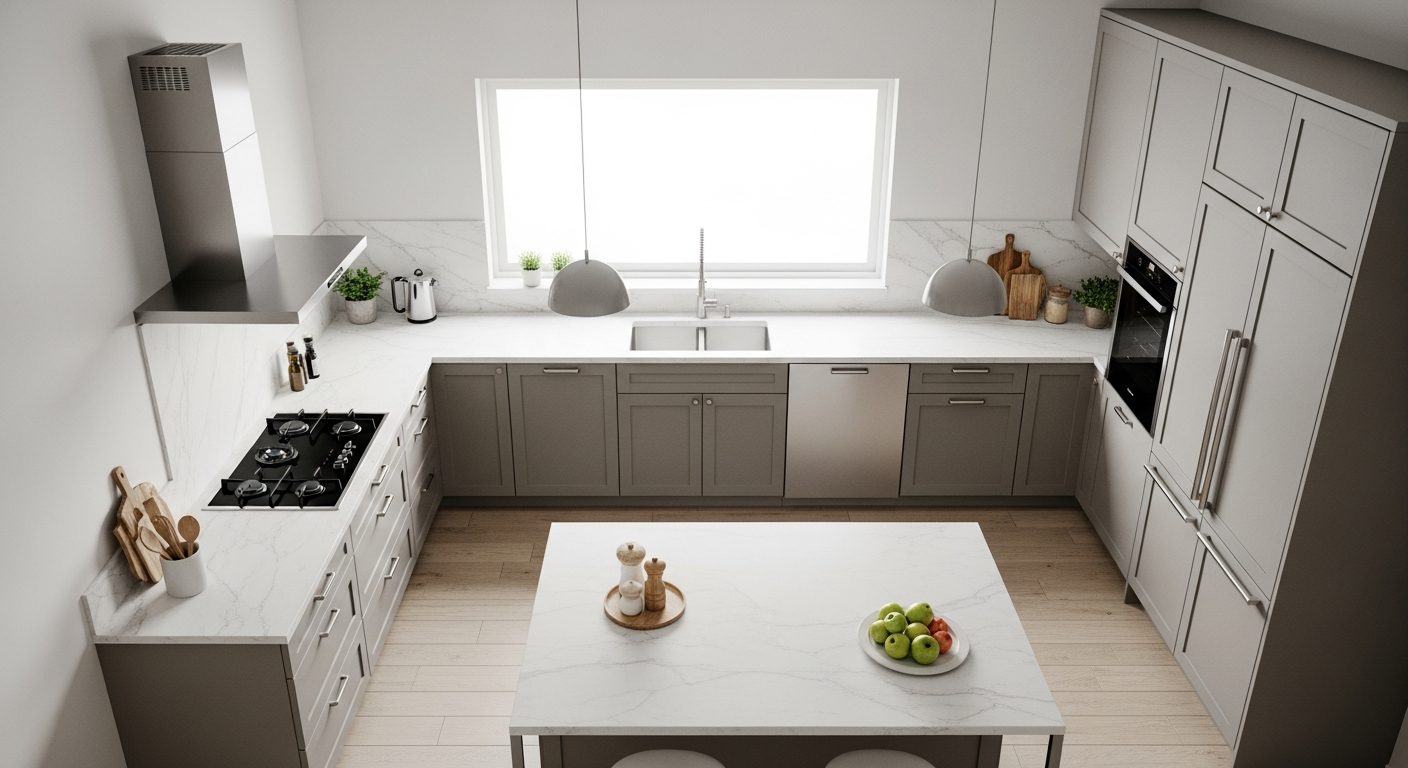
Three walls of cabinetry forming a U. This layout maximizes storage and counter space, making it ideal for serious cooks. The work triangle fits comfortably within the U. The downside is that it can feel enclosed, and it requires a room that's at least 10 feet wide (12 to 14 feet is more comfortable). In larger rooms, adding a small island in the centre creates an extremely functional kitchen.
A U-shaped layout with a peninsula extending from one wall, forming a G. The peninsula adds counter space and can serve as a casual eating bar. It works well when you want island-like functionality but don't have room for a freestanding island with clearance on all sides.
This is the most requested layout in kitchen renovations across the Kitchener-Waterloo area. The L provides the working kitchen, while the island adds prep space, seating, and storage. The island often faces the living or dining area, creating a natural boundary in open concept homes.
This sounds obvious, but some layouts separate them for aesthetic reasons. Rinsing a dish and loading the dishwasher should be a single motion, not a three-step journey.
When the dishwasher, oven, or refrigerator door is open, can you still move through the kitchen? Draw the arc of every appliance door on your floor plan and check for conflicts. A common problem: the dishwasher door blocks access to a lower cabinet when it's open.
You need a place to set bags and items when loading or unloading the refrigerator. At least 15 inches of counter space beside the fridge handle side prevents the awkward dance of holding the door open with your hip while reaching for a distant counter.
If your kitchen is a thoroughfare between the garage and the living room, the main traffic path should not cross through the work triangle. People walking through while you're cooking is both annoying and unsafe. Position the layout so the work area is set back from the main traffic route.
A pull-out garbage and recycling bin near the prep area and sink saves countless steps. This is one of the small details that makes a huge difference in daily life. Plan for it in the cabinet layout from the beginning, because retrofitting a pull-out bin into existing cabinetry is difficult.
Before committing to a layout, test it in your actual space:
Not every kitchen is a neat rectangle. Older homes in Kitchener's Victoria Park neighbourhood, Waterloo's Lakeshore Village area, and Cambridge's older downtown often have irregular kitchen spaces — odd angles, support columns, radiators, or bump-outs for chimneys.
These challenges are manageable with creative layout planning. A skilled designer can use angled cabinets to wrap corners smoothly, turn structural columns into visual features, and work around existing windows and doors. Custom or semi-custom cabinets (which can be built to non-standard dimensions) are especially valuable in irregular spaces. See our cabinet door styles to get an idea of what's possible.
A well-planned kitchen layout pays dividends every day. It's the difference between enjoying the cooking process and dreading it, between a kitchen that flows and one that fights you at every turn.
Take the time to sketch, tape, and test before any cabinets are ordered or walls are moved. And when you're ready for expert input, visit our showroom at 899 Victoria St N in Kitchener. We'll help you find a layout — and the cabinetry and countertops to go with it — that suits your home, your cooking style, and your budget. Contact us or call (519) 744-2284 to book a visit.
Answers to your renovation questions
Each leg of the work triangle should be between 4 and 9 feet, with all three legs adding up to 13 to 26 feet. Stay inside that range and you move between fridge, sink, and stove in a natural flow. Too tight feels cramped; too spread out turns cooking into a marathon. We map these distances in 3D for every kitchen we design, so you can test the flow before any cabinets are built.
Galley and one-wall layouts work best in small Kitchener homes and condos because they keep everything within a step or two. Many older KW homes have galley kitchens that perform beautifully once updated with modern cabinetry and smart organization. A portable island can add a second counter run where space is tight. Our small kitchen renovation ideas cover more space-saving moves.
Not always. An island earns its place when you have room for it without crowding the work triangle, since a poorly placed island that blocks the path between sink and stove hurts more than it helps. In an L-shaped or U-shaped kitchen with enough width, an island adds prep space and seating. Our kitchen island design guide covers the sizes and clearances that make an island work.
Place the dishwasher directly beside the sink, ideally on the side closest to where you store dishes, so unloading is a simple pivot rather than a walk across the kitchen. Keeping the sink and dishwasher together is one of the highest-impact layout decisions in the cleaning zone. Thoughtful placement like this also frees up cabinet storage for everyday items right where you need them.
The work triangle connects three points (sink, stove, fridge) and suits one cook in a compact kitchen, while the zone approach organizes the kitchen into five task areas: storage, prep, cooking, cleaning, and serving. Zones handle modern realities like two cooks, islands, and coffee stations that a strict triangle ignores. Most good designs use both. A free design consultation can apply both principles to your actual room.
The biggest mistakes are blocking appliance doors, crossing the work triangle with an island, and putting too little counter beside the fridge and stove. Plan landing space next to both, keep traffic paths clear of the triangle, and confirm clearances before ordering cabinets. Designing in 3D first catches most of these on screen. Our list of kitchen renovation mistakes to avoid covers the rest.
Have more questions? We’re here to help.
Come see the cabinets and finishes in person at 899 Victoria St N, Kitchener — or fill out the form and our team will get back to you about your kitchen or bath project.