10 Years on Victoria StreetSave up to $1,000 on your kitchen or bath. Print your coupon and bring it in.Get the coupon
✕
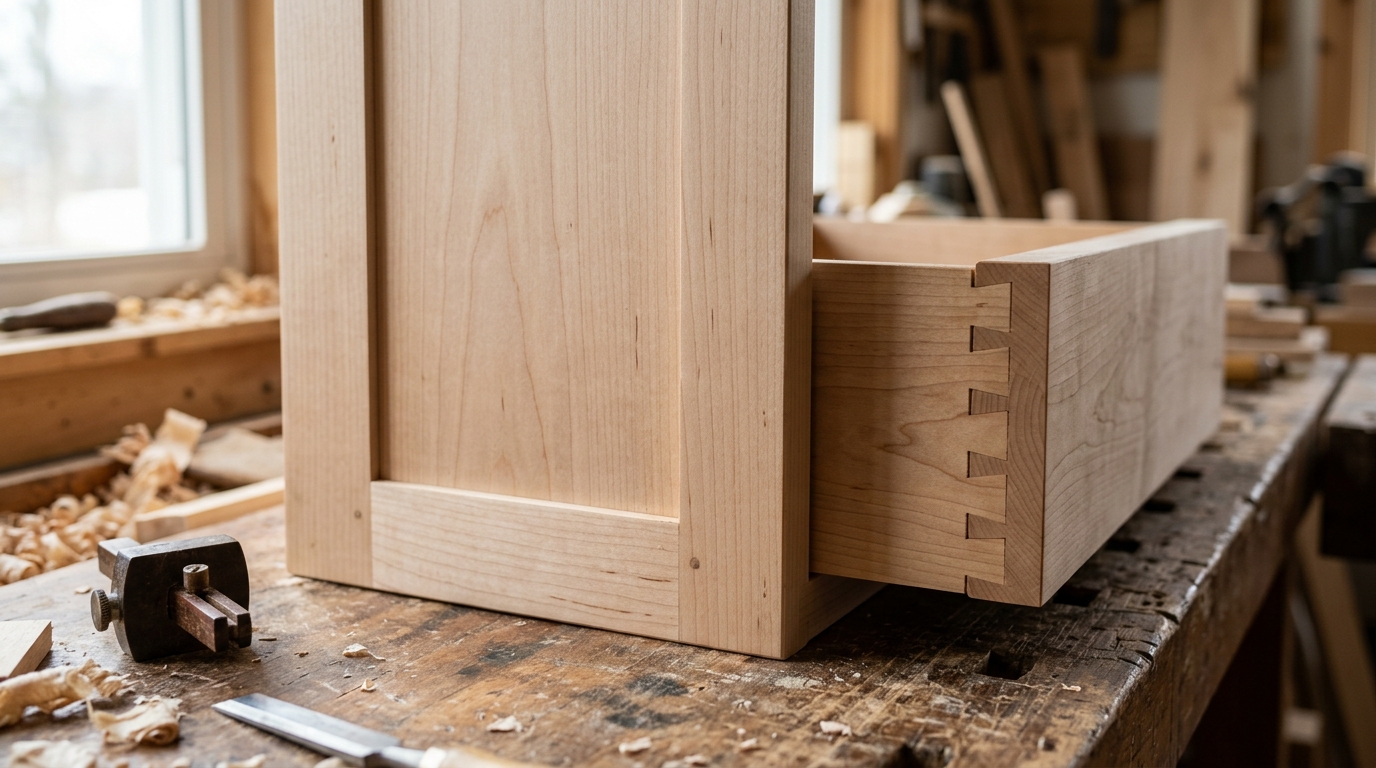
Cabinets built with solid maple doors on a plywood box are stronger, more moisture-resistant, and far more durable over decades than cabinets built entirely from MDF or particle board — which is why they hold up better in a busy Kitchener kitchen, even though all-MDF boxes cost less up front. Cabinet construction is the single biggest factor in how long your kitchen lasts, and it is the one most homeowners never see behind a pretty door front.
Here is the honest difference between the two, with no marketing spin.
Solid maple is a dense hardwood — at Kitchen & Bath World it is what we use for the parts you see and touch every day: the door panels, drawer fronts, and face frames. Behind them, the cabinet box itself is built from plywood, an engineered wood that stays dimensionally stable and grips screws and hinges far better than the alternatives. MDF (medium-density fibreboard) and particle board are a different animal — panels made from wood fibres or chips bonded with resin and pressed into sheets. MDF is smoother and denser than particle board, but both are fundamentally different from solid wood and plywood in how they perform over time.
This is where the gap shows. Solid maple doors resist dents and can be repaired or refinished, and a plywood box holds screws and hinges securely for decades. It also lets us hang hardware that lasts: dovetail-jointed drawer boxes on concealed undermount roll tracks, soft-close door hinges, and adjustable plywood shelves on premium metal brackets. MDF and particle board are prone to chipping at the edges, can sag under the weight of heavy dishes or stone countertops, and strip out at screw points after repeated use — which is why drawer fronts and hinges on cheaper cabinets start to loosen within a few years of heavy use.
Kitchens and bathrooms are humid, and the area under the sink sees the occasional leak. When MDF or particle board absorbs water, it swells, crumbles, and cannot be brought back. Plywood and solid maple handle humidity and minor spills far better — plywood's cross-laminated layers resist swelling, and maple faces can be dried and refinished. This is the same reason we build our bathroom vanities with solid maple doors on a plywood box rather than particle board — see our explanation of solid wood vs. particle board vanities.
To be fair, MDF is not useless. Its smooth, seamless surface is actually ideal for painted door fronts because it has no wood grain to telegraph through paint, and it is dimensionally stable for large flat panels. Many quality cabinets pair a plywood box and solid-wood frames with MDF centre panels on painted doors — a sensible hybrid. The problem is cabinets built entirely from particle board or MDF, including the structural boxes.
MDF and particle board cabinets cost less up front, which is why they fill flat-pack and big-box options. But if they fail or swell in 7 to 10 years and need replacing, the "savings" disappear. Solid maple doors and a plywood box cost more initially and routinely last the life of the kitchen — often 25 years or more — making them the better value for a home you plan to stay in. If you are weighing your options, our guide to custom vs. semi-custom vs. stock cabinets covers how construction and price interact.
At Kitchen & Bath World, every cabinet is built the same way: a solid maple door panel and drawer fronts on a plywood box, with dovetail drawer boxes riding on concealed undermount roll tracks, soft-close door hinges, adjustable plywood shelves on premium metal brackets, and quiet door bumpers so nothing slams. It is a deliberate choice — particle board and MDF boxes have no place in it. In a Kitchener kitchen that sees daily use for decades, that construction is what separates a kitchen you love from one you are repairing. You can see and feel the difference in our showroom — open a drawer, check the dovetail joinery, and compare.
See our solid maple and plywood-box construction up close and compare it for yourself. Explore our kitchen cabinets, browse the project gallery, or book a free design consultation. Visit Kitchen & Bath World at 899 Victoria St N, Kitchener, or call (519) 744-2284 — serving Kitchener, Waterloo, Cambridge, and Guelph.
Answers to your renovation questions
Not all, but most budget and flat-pack lines use MDF or particle board for the cabinet boxes to hit a low price. The doors may look identical to solid wood, so you have to ask directly what the box is built from. Kitchen & Bath World builds its doors and drawer fronts from solid maple on a plywood box — never particle board — instead. See how this compares in our solid wood vs. particle board guide.
Check a cut edge or the inside of a door: solid maple shows continuous wood grain, while MDF shows a smooth, uniform brown core and particle board shows speckled chips. Solid wood also feels firm but not dead-heavy, and screws bite cleanly. If you're planning a refresh instead of a rebuild, our refacing vs. replacing guide explains when each makes sense.
Yes, solid maple costs more up front, but usually less over the life of the kitchen. In 2026 Kitchener-Waterloo pricing, a solid maple kitchen typically starts a few thousand dollars above a comparable MDF or particle-board layout. Because maple often lasts 25 years or more, the per-year cost is lower. For total project budgeting, see our Kitchener kitchen renovation cost guide.
Solid maple holds up better. Quartz and porcelain countertops are heavy, and MDF or particle-board boxes can sag or strip at screw points under sustained weight, while a plywood box keeps its structure for decades. This matters if you're installing quartz or porcelain countertops. Kitchen & Bath World builds plywood boxes with solid maple faces specifically to carry stone tops without flexing over time.
Yes, for painted door panels specifically. MDF has no grain to telegraph through paint, so it gives a smooth, seamless painted finish, and it's dimensionally stable for large flat panels. The smart approach is a plywood box and solid-wood frames with MDF centre panels on painted doors, never MDF as the structural box. If you're deciding on a finish, see our painted vs. stained cabinets guide.
Yes. The best way to judge construction is to open a drawer, check the joinery, and feel the box weight in person. Kitchen & Bath World's Kitchener showroom at 899 Victoria St N lets you compare solid maple directly, and design is free. Explore the kitchen cabinet range or browse the project gallery first, then visit to see the difference yourself.
Have more questions? We’re here to help.
Come see the cabinets and finishes in person at 899 Victoria St N, Kitchener — or fill out the form and our team will get back to you about your kitchen or bath project.