
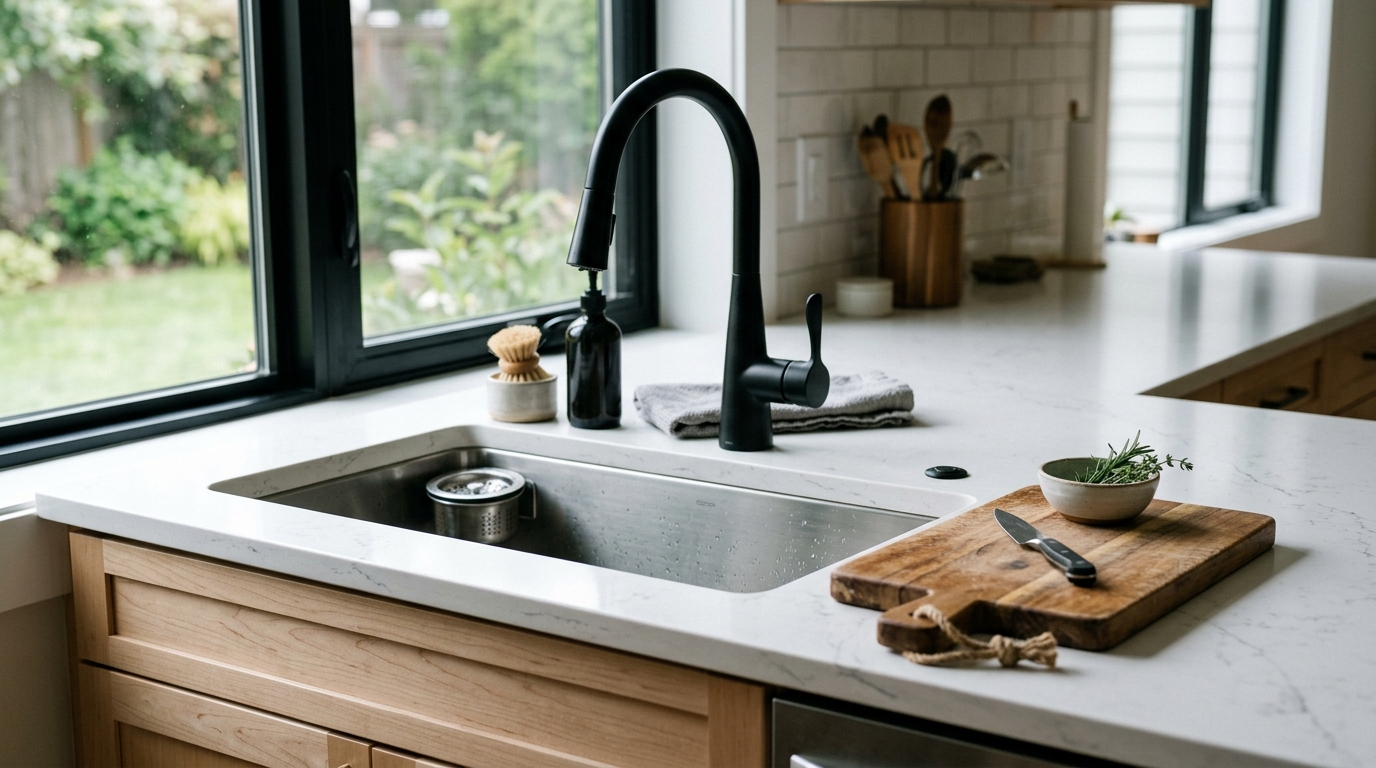
The short answer: an undermount sink is the better choice with quartz or porcelain countertops, while a drop-in sink is the practical choice with laminate or when you're keeping your existing counter. Undermounts sit below the countertop, so you can wipe crumbs and water straight into the bowl and there's no rim to clean around. Drop-ins sit on top of the counter, cost less to install, and are far easier to replace later.
Both work in kitchens and bathrooms. The right one depends mostly on your countertop material, then on how you cook and clean, and then on budget. Here's how they compare.
A drop-in sink is lowered into a hole cut in the countertop. Its rim rests on top of the counter and carries the weight of the sink, sealed with a bead of silicone and often held with clips underneath. Because the rim covers the cut edge, the cutout doesn't need to be finished or polished. That's why drop-ins work with almost any countertop, including laminate and butcher block, and why they're a common DIY swap.
An undermount sink is attached to the underside of the countertop, so the finished edge of the cutout is exposed and becomes part of the look. That means the countertop material has to be solid all the way through, water-resistant at the cut edge, and strong enough to support a sink full of water and dishes. The fabricator cuts and polishes the opening to the sink's exact template, and the sink is bonded and mechanically fastened to the underside of the stone.
Quartz and porcelain are non-porous and solid through their full thickness, so the polished edge around an undermount cutout holds up well to water. That's why almost every quartz or porcelain kitchen you see has an undermount sink. You can cut a drop-in hole into quartz, but you'd be paying for a premium surface and then covering its best feature with a rim. If you're choosing between the two materials, our comparison of porcelain vs quartz countertops covers the differences in cost and durability.
Laminate is a thin plastic layer glued over a particleboard core. An undermount cutout exposes that core, and if water gets in, it swells and breaks down. Formica does describe undermount options for laminate using specific sink and sealing systems, but for most budget kitchens a drop-in is the safer, lower-risk match.
Some solid-surface and engineered tops are made with the sink bowl moulded into the counter itself. An integrated sink has no seam at all, which makes it the easiest to clean, but if the bowl is damaged you're usually replacing or repairing the whole top.
With an undermount, you choose how the countertop edge meets the sink. This is called the reveal:
Fabricators such as Eastern Surfaces explain the trade-offs in more detail. Whatever you pick, confirm it at templating so it's cut the way you expect.
Kitchen sinks are bigger and heavier, and they take far more abuse: stock pots, cast iron pans, a full basin of water. That puts real load on an undermount's mounting, which is why it matters that it's installed by the people who fabricated the top. The daily cleaning advantage of an undermount is also biggest in the kitchen, where you're constantly wiping food off the counter.
Drop-ins still make sense in kitchens when you're keeping the existing counter, working with laminate, or refreshing a rental on a tight budget.
Bathroom sinks are smaller and lighter, and the main mess is toothpaste, soap and water. An undermount with a quartz or porcelain top makes wiping down the vanity a ten-second job. Sink style also affects height: undermount and drop-in sinks keep the usable height at the counter, while vessel sinks add several inches. Our guide to standard bathroom vanity height covers what that means for comfort.
Our bathroom vanities come with the countertop and sink included, so the pairing is sorted out for you rather than left for you to match up after the fact.
Each style has its own weak spot:
For the counter itself, quartz needs little more than warm soapy water and a soft cloth; avoid harsh chemicals and put hot pots on trivets. Our quartz countertop care guide has the full list.
The sink itself can cost about the same either way; many sinks are even sold as dual-mount. The price gap is in fabrication and installation. An undermount needs a cutout polished to a finished edge and professional mounting, while a drop-in cutout is hidden under the rim. On a quartz or porcelain job, the undermount cutout is normally part of the countertop fabrication rather than a separate trade.
In Kitchener-Waterloo, quartz and porcelain counters generally run $60 to $120 per square foot installed. For a full breakdown, including how cutouts and edges affect the quote, see our guide to quartz countertop prices in Kitchener-Waterloo.
For most of the kitchens and bathrooms we design, where the counter is quartz or porcelain, undermount is the natural fit.
The sink and countertop are best chosen as a pair, and it's much easier to judge the look when you can see it in your own layout. At Kitchen & Bath World, we design every kitchen and bathroom in 3D before anything is built, and our quartz and porcelain countertops are templated and installed locally by our team.
Visit our showroom at 899 Victoria St N in Kitchener to see countertop finishes in person, or request a free estimate.
Answers to your renovation questions
An undermount sink is better if you have quartz, porcelain or other solid stone counters, because there's no rim to clean around and you can wipe crumbs straight into the bowl. A drop-in is better with laminate, on a tight budget, or when you want to swap the sink easily later. Most quartz kitchens use undermount. Compare surfaces in our guide to porcelain vs quartz countertops.
Yes, a drop-in sink can be installed in quartz; the fabricator simply cuts an opening the rim will cover. It's uncommon, though, because the rim hides the clean edge that makes quartz worth paying for, and it brings back the grime line around the sink. Most homeowners choose undermount with quartz. See what quartz costs installed in our Kitchener-Waterloo quartz price guide.
It's possible with specific sink and sealing systems, but it's generally not recommended for a standard laminate top. An undermount cutout exposes the particleboard core, and if water reaches it, the core swells and breaks down. A drop-in sink covers that edge and is the safer match. If you want an undermount, upgrading to a quartz or porcelain top is the more reliable route. Explore our quartz and porcelain countertops.
A properly installed undermount sink should not fall off. Failures usually come from adhesive alone without mechanical clips, a failed seal that lets water in, or DIY mounting. Having the countertop fabricator mount the sink with both adhesive and fasteners is the best protection. Check the joint occasionally for gaps. For daily upkeep of the surrounding counter, read our quartz countertop care guide.
Yes, undermount sinks usually cost more to install because the countertop cutout has to be polished to a finished edge and the sink must be professionally mounted. The sink itself often costs about the same as a drop-in. On a quartz or porcelain job, the undermount cutout is typically included in the countertop fabrication. Kitchen & Bath World provides free estimates; request one here.
For most bathroom vanities with a quartz or porcelain top, an undermount or integrated sink is best because it's the easiest to keep clean. Vessel sinks make a statement but add several inches of height and splash more. Drop-ins suit laminate tops. Kitchen & Bath World's bathroom vanities include the countertop and sink, so the pairing is already worked out.
Have more questions? We’re here to help.
Come see the cabinets and finishes in person at 899 Victoria St N, Kitchener — or fill out the form and our team will get back to you about your kitchen or bath project.