10 Years on Victoria StreetSave up to $1,000 on your kitchen or bath. Print your coupon and bring it in.Get the coupon
✕
Quartz has been the default premium countertop for years, but porcelain slabs are now a serious alternative — and we get asked about the difference almost every week in our showroom. The short version: quartz is more forgiving and offers more design and edge options, while porcelain is more heat-resistant, lighter, and better suited to outdoor or high-sun spaces. Both cost roughly the same installed in Kitchener-Waterloo, in the range of $60 to $130 per square foot.
Both are excellent surfaces, and the right choice comes down to how you use your kitchen and what you value most. Here’s an honest comparison to help you decide.
Both are engineered, man-made surfaces, but they’re made very differently.
Quartz is engineered stone — roughly 90% to 94% ground natural quartz mixed with resins and pigments, then formed into slabs. The resin is what makes quartz slightly flexible, stain-resistant, and easy to fabricate. You can read more in our guide to quartz vs. granite vs. marble.
Porcelain is made from natural clay and minerals fired at extremely high temperatures — above 2,200°F. That firing process makes porcelain exceptionally hard, completely non-porous, and highly heat-resistant. Porcelain slabs are also much thinner than quartz, typically 6mm to 12mm versus quartz’s 20mm to 30mm.
Installed, quartz countertops typically run $65 to $130 per square foot in Kitchener-Waterloo, depending on the brand, colour, and edge profile.
Installed, porcelain countertops typically run $60 to $120 per square foot in Kitchener-Waterloo. Material alone can be slightly cheaper than quartz, but the specialized fabrication often brings the installed price into the same range.
Here’s how the two stack up on the factors that matter most:
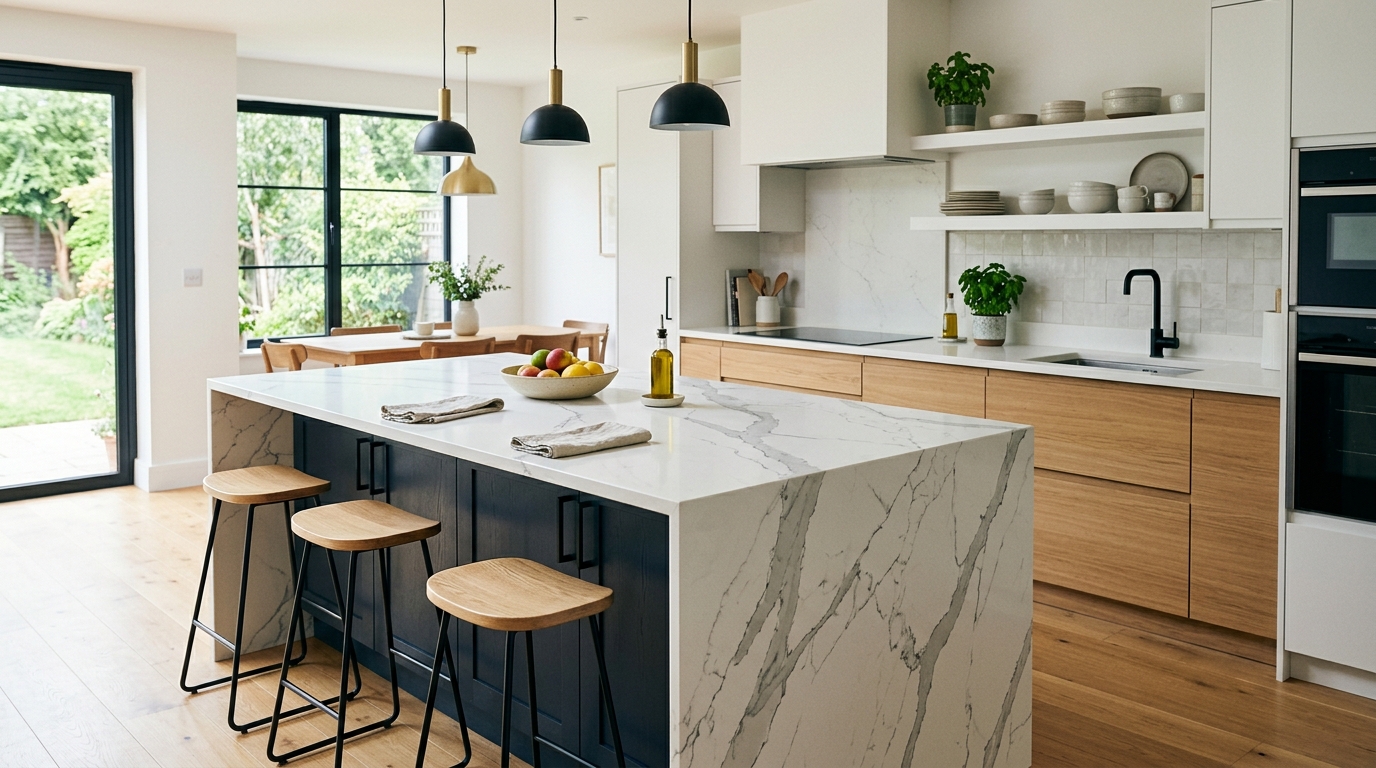
For most indoor Kitchener kitchens, quartz remains the most practical all-rounder — forgiving, beautiful, and endlessly versatile. Choose porcelain if heat resistance is a top priority, if you’re building an outdoor kitchen or a sun-drenched space, or if you love the look of a thin, large-format waterfall island.
Whichever you choose, the surface is only as good as the cabinetry it sits on. We pair both quartz and porcelain with our solid maple cabinets, templated and installed by our own team. You can see the full range on our countertops page, or read our guide to choosing the right countertop material.
At Kitchen & Bath World, we’ve helped Waterloo Region homeowners choose countertops for over ten years, and we design every kitchen in 3D so you can see your materials together before you commit. Visit our showroom at 899 Victoria St N in Kitchener to compare porcelain and quartz samples in person, or request a free estimate.
Answers to your renovation questions
For everyday family use, quartz is the more forgiving surface. Its resin content gives it slight flex, so edges and corners resist chipping better than porcelain, which is harder but more brittle. Both shrug off daily wear and need only soap and water. Porcelain wins on heat, quartz wins on impact. Compare both against natural stone in our quartz vs. granite vs. marble guide.
Only on porcelain. Because porcelain is fired above 2,200°F, you can set a hot pot on it without scorching. Quartz can scorch—direct heat damages its resin, so always use a trivet. If you cook often and set pans down without thinking, porcelain is the safer surface. Either way, both pair with our solid maple cabinets; explore options on our countertops page.
Both run roughly $60 to $130 per square foot installed in Kitchener-Waterloo in 2026. Porcelain material can be slightly cheaper, but its specialized fabrication usually closes the gap. Brand, colour, and edge profile move the price more than the material choice itself. KW pricing typically sits below the GTA. For quartz specifically, see our 2026 quartz price breakdown.
No. Both quartz and porcelain are non-porous and never need sealing, unlike natural stone. Routine care is just soap and water. This is one of the biggest advantages over granite and marble, which require periodic resealing. For day-to-day upkeep on engineered surfaces, our quartz care and cleaning guide covers what to avoid and how to keep the finish looking new.
Porcelain is the clear choice for outdoor kitchens, sunrooms, and bright south-facing spaces. It's UV-stable and won't fade, while some quartz colours can lighten under prolonged direct sunlight. Porcelain is also lighter, which suits waterfall islands and full-height backsplashes. For an indoor kitchen without intense sun, quartz remains the practical all-rounder. See more material options in our countertop material guide.
Yes. A countertop is only as stable as the cabinetry supporting it. Heavy quartz and porcelain slabs need a solid, level base; particle board boxes can sag or swell over time, throwing off seams and support. Kitchen & Bath World builds cabinets from solid maple, never MDF or particle board. Learn why construction matters in our solid maple vs. MDF cabinets guide.
Have more questions? We’re here to help.
Come see the cabinets and finishes in person at 899 Victoria St N, Kitchener — or fill out the form and our team will get back to you about your kitchen or bath project.