
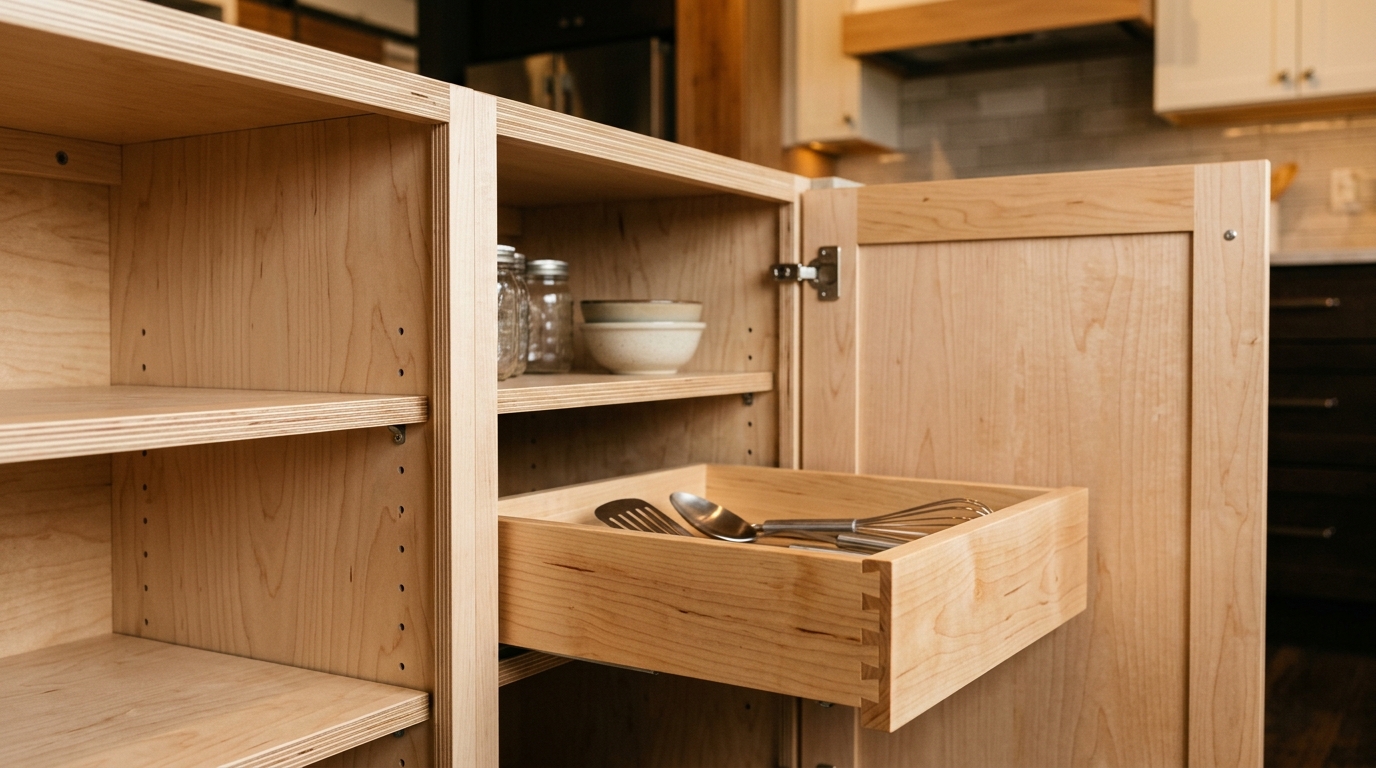
A plywood cabinet box holds screws and hinges more securely, recovers far better from a leak, and weighs less than a particleboard box, which is why it lasts longer in a kitchen or bathroom; particleboard costs less up front but swells permanently once water gets into it. The box is the part of a cabinet you rarely look at, and it's the part that decides whether your doors still hang straight in fifteen years.
Our post on solid maple vs MDF cabinets covers what your doors and drawer fronts are made of. This one goes behind the door, to the sides, bottom, back and shelves that carry the load.
The box (sometimes called the carcass or case) is everything except the doors and drawer fronts: two side panels, a bottom, a back, top rails or a top panel, and the shelves. It does three jobs. It carries weight, including your dishes and, in a base cabinet, a stone countertop. It anchors hardware, since hinge plates and drawer glides screw into the side panels. And it has to stay square, so doors line up and drawers run smoothly.
The door gets the attention in the showroom. The box does the work for the next twenty years.
Plywood is made from thin sheets of real wood veneer glued together with the grain of each layer running at right angles to the one beside it. That cross-grain construction is what gives plywood its strength and stops it from moving much with changes in humidity.
Particleboard is made from wood chips, shavings and sawdust mixed with resin and pressed into a flat sheet. For cabinet boxes it's usually faced with a thin melamine layer (often white or a wood-look print), which is why many flat-pack and budget cabinets have that smooth, plastic-feeling interior. The face is durable; the core underneath is the weak point.
Every time you open a door, the hinge pulls on the screws in the cabinet side. In plywood, those screws cut threads into layers of real wood fibre and stay put. In particleboard, the threads bite into compressed chips, and over years of use, or one overtightened screw during a repair, the hole can strip out. A stripped hinge screw in particleboard is hard to fix properly, and it's the usual reason doors on budget cabinets start to sag and rub. Undermount drawer glides, which also screw into the box sides, have the same dependency.
This is the biggest difference in a kitchen or bathroom. When particleboard gets wet, the chips absorb water through any exposed edge, screw hole or chipped corner, and the panel swells. That swelling is almost always permanent: the board stays puffed up and soft, and the melamine face often lifts. Plywood can swell when soaked too, but it tends to swell more evenly and largely return to shape as it dries, especially if the leak is caught quickly.
The sink base is where this shows up first. A slow drip from a supply line or a dishwasher connection can go unnoticed for weeks. In a particleboard sink base, that usually means replacing the cabinet. In a plywood sink base, it usually means drying it out and fixing the plumbing. It's the same reason we build our bathroom vanities on a plywood box; our post on solid wood vs particle board vanities covers the bathroom side in more detail.
Quartz and porcelain countertops are heavy, and base cabinets carry them for decades. Plywood's cross-laminated layers resist bending and hold their shape under a load. Particleboard is weaker along its length, so long shelves and wide panels are more prone to sagging over time, particularly when loaded with dishes or cookware. If you're pairing new cabinets with quartz or porcelain countertops, the box underneath matters as much as the slab on top.
Particleboard is generally denser and heavier than plywood of the same thickness, so a particleboard cabinet is often heavier to carry and hang, despite being the weaker material. On wall cabinets, the box is also what the mounting screws pass through into the wall studs, so the material around those screws matters.
Particleboard's one real advantage is price. It's cheaper to produce and machine, which is why it dominates flat-pack and big-box cabinet lines. Plywood adds to the cost of a cabinet. Whether that's worth it depends on how long you plan to keep the kitchen; if the answer is "a long time," a box that survives a leak and still holds its hinges usually costs less over its life than one you replace. Our guide to custom vs semi-custom vs stock cabinets looks at how construction and price interact across cabinet tiers.
Both plywood and particleboard are made with adhesives, and both are covered by federal rules in Canada. The Formaldehyde Emissions from Composite Wood Products Regulations (SOR/2021-148) came into force on January 7, 2023 and set emission limits for hardwood plywood, particleboard and MDF sold in Canada. So this is less of a reason to choose one over the other than it used to be; buy from a supplier who can tell you where their cabinets come from.
To be fair, particleboard isn't useless. In a dry room with light loads, such as a closet organizer, a home office desk, or a bookshelf that never sees water, a well-edged melamine particleboard panel can perform acceptably for years. The trouble starts in the two rooms where cabinets face daily water, steam and weight: the kitchen and the bathroom. Laundry rooms belong on that list too.
Showroom displays rarely advertise their box material, so check it yourself:
Also check the hardware that the box is carrying. Dovetail drawer boxes, concealed undermount glides and soft-close hinges all rely on the box sides to stay square and hold their screws.
Every cabinet and vanity we sell is built on a plywood box, never particleboard. Doors and drawer fronts are solid maple; gloss and slab door styles use an MDF door panel, but the box behind them is still plywood. Inside, you'll find adjustable plywood shelves on premium metal brackets, dovetail drawer boxes on concealed undermount glides, soft-close hinges and quiet door bumpers. You can see the full range on our kitchen cabinets page.
The best test is hands-on: open a drawer, look at the edge of a shelf, and compare the weight and feel yourself. At our showroom at 899 Victoria St N in Kitchener, you can inspect exactly how our boxes are built, and we'll design your kitchen or bathroom in 3D before anything is made, so you see the finished layout first. Our team installs every cabinet and vanity.
Serving Kitchener, Waterloo, Cambridge and Guelph. Stop by the showroom or request a free estimate.
Answers to your renovation questions
Plywood is better for kitchen cabinet boxes. It holds hinge and glide screws more securely, resists sagging under stone countertops, and largely recovers from a leak, while particleboard swells permanently once soaked. Particleboard's advantage is a lower price. For how door materials compare, a separate question, read our solid maple vs MDF guide.
Particleboard absorbs water through exposed edges, screw holes and chipped corners, then swells. The swelling is almost always permanent: the panel stays puffy and soft, the melamine face can lift, and screws lose their grip. The sink base is usually the first cabinet to fail. That's why bathroom cabinets especially should be plywood; see our solid wood vs particle board vanity comparison.
Look at an exposed edge, such as the front of a shelf or the back edge of a side panel. Plywood shows thin stacked layers of wood; particleboard shows a speckled core of compressed chips, usually behind edge banding. Shelf-pin holes are another giveaway: particleboard looks crumbly inside. Planning a new kitchen? Start with our showroom visit guide.
For a kitchen or bathroom you plan to keep, usually yes. Plywood costs more up front, but a single leak under the sink can ruin a particleboard base, and stripped hinge screws cause sagging doors over time. Replacing cabinets early erases the savings. For how cabinet construction fits into a full budget, see our Kitchener kitchen renovation cost guide.
Yes. Plywood's cross-laminated layers resist bending and hold screws firmly, so a properly installed plywood base cabinet carries a quartz or porcelain countertop without sagging for decades. Particleboard is more prone to sag and to losing its screw grip under long-term weight. Compare slab options on our quartz and porcelain countertops page.
No. Every Kitchen & Bath World cabinet and vanity is built on a plywood box, with adjustable plywood shelves, dovetail drawer boxes and soft-close hinges. Doors and drawer fronts are solid maple, while gloss and slab styles use an MDF door panel on the same plywood box. See the range on our kitchen cabinets page.
Have more questions? We’re here to help.
Come see the cabinets and finishes in person at 899 Victoria St N, Kitchener — or fill out the form and our team will get back to you about your kitchen or bath project.