10 Years on Victoria StreetSave up to $1,000 on your kitchen or bath. Print your coupon and bring it in.Get the coupon
✕
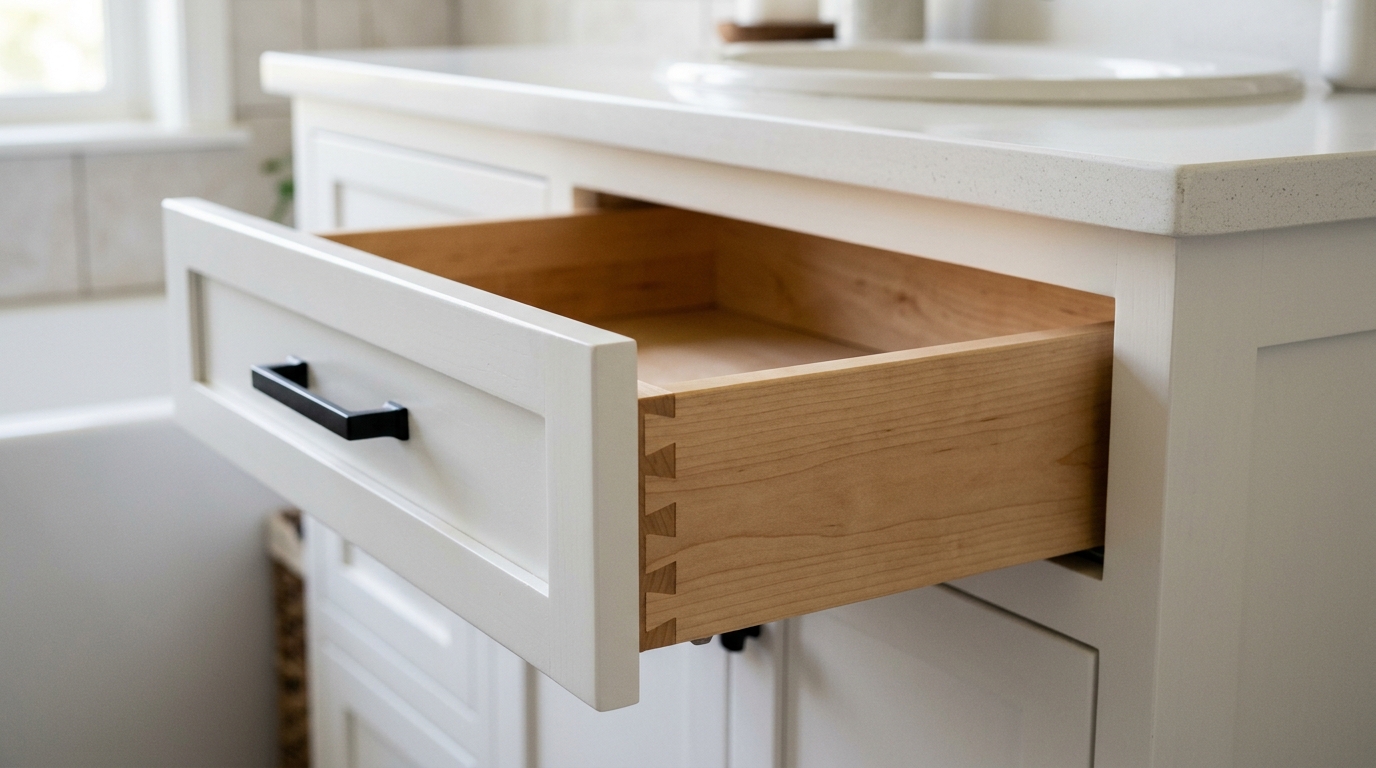
The single most important difference between a bathroom vanity that lasts twenty years and one that fails in five isn’t the finish or the hardware — it’s what the cabinet is made of. Solid maple doors on a plywood box survive the humidity and water of a real bathroom; particle board and MDF do not. Two vanities can look identical in the showroom and have completely different lifespans once they’re under a sink.
Here’s what each material actually is, how it holds up, and how to tell what you’re really buying.
Particle board is made from wood chips and sawdust bound together with glue and pressed into panels. It’s the cheapest cabinet material, which is why it’s used in most big-box and budget vanities. It’s heavy, holds screws poorly, and — critically — acts like a sponge. Once water gets past the thin laminate coating, particle board swells, crumbles, and never recovers.
MDF is a finer, denser version of the same idea — wood fibres and resin pressed into smooth panels. It’s better than particle board for painted doors because it has no grain and takes paint cleanly. But the core is still vulnerable to moisture: if the sealed surface is breached, MDF swells much like particle board.
Plywood is made from thin layers of real wood glued in alternating grain directions. That cross-laminated structure is what makes it strong and dimensionally stable — it holds screws and hinges well and resists swelling and moisture far better than particle board or MDF. It’s why quality cabinet boxes, including the ones we build, are made from plywood rather than pressed panel.
Solid wood — like the solid maple we use for doors and drawer fronts — is exactly what it sounds like: real lumber, not pressed chips or fibres. It’s the most durable and the most water-tolerant material for the faces of a vanity. It can be sanded and refinished, it holds hardware indefinitely, and it stands up to the daily humidity swings of a bathroom for decades. Paired with a plywood box, it gives you a vanity that’s stable everywhere it matters.
A bathroom is the hardest environment in your home for cabinetry. Hot showers create humidity that rises and falls every day. The cabinet under the sink lives inches from supply lines and a drain. Small leaks are common and often go unnoticed for weeks.
In that environment, the difference between materials becomes dramatic:
Manufacturers don’t always make this easy, so check for yourself:
A vanity with solid maple doors on a plywood box costs more up front — but it’s usually the cheaper choice over the life of the bathroom. A $500 particle-board vanity you replace twice in fifteen years costs more in money and hassle than one quality vanity that lasts the whole time. You also avoid the disruption of tearing out and reinstalling. We break the numbers down in our guide to bathroom vanity costs in Kitchener.
At Kitchen & Bath World, every vanity we build uses solid maple doors and drawer fronts on a plywood box — no particle board, no MDF cores — because we’ve spent over ten years watching which vanities survive Waterloo Region bathrooms and which ones don’t. The drawers are dovetailed and ride on concealed undermount roll tracks, with soft-close hinges, adjustable plywood shelves on premium metal brackets, and quiet door bumpers throughout. We design each one in 3D so it fits your space exactly, and we stand behind it.
Come see and feel the difference at our showroom at 899 Victoria St N in Kitchener, or request a free estimate.
Answers to your renovation questions
A vanity with solid maple doors on a plywood box routinely lasts 20 years or more, often the full life of the bathroom, because it tolerates humidity, the faces can be sanded and refinished, and it holds hardware indefinitely. By contrast, particle-board and MDF vanities frequently fail within three to seven years once moisture reaches the core. Kitchen & Bath World builds every vanity with solid maple doors and drawer fronts on a plywood box, with no particle board. See the full vanity range.
Ask directly: "Are the doors solid wood, and is the cabinet box plywood, MDF, or particle board?" A reputable seller answers plainly; if they dodge it, that's your answer. Also ask whether the drawers are dovetailed and how the top is sealed. For a bigger-picture buying checklist, see our guide to where to buy a vanity in Kitchener-Waterloo before you visit showrooms.
Usually yes, because it's often cheaper over time. A $500 particle-board vanity replaced twice in fifteen years costs more in money and disruption than one vanity with solid maple doors on a plywood box that lasts the whole time, plus you avoid repeated tear-out and reinstall. Kitchen & Bath World offers free estimates, so you can compare real numbers. For pricing context, read our bathroom vanity cost guide for Kitchener.
Because the bathroom is the harshest environment in the home for cabinetry. Daily humidity swings from hot showers, plus supply lines and a drain inches away, mean small leaks are common and often unnoticed for weeks. Particle board and MDF swell and delaminate in that setting, while solid maple doors and a cross-laminated plywood box shrug it off. The same logic applies to kitchens, covered in our solid maple vs. MDF cabinets guide.
Plywood is a strong, moisture-resistant choice and is exactly what a quality cabinet box should be made of. Its cross-laminated layers hold screws and hinges well and resist water far better than particle board or MDF. Solid wood, meanwhile, is the most durable and refinishable option for the doors and drawer fronts. Kitchen & Bath World pairs the two — solid maple faces on a plywood box; you can request a free estimate to compare options for your bathroom.
Kitchen & Bath World serves all of Waterloo Region from its Kitchener showroom at 899 Victoria St N, building every vanity with solid maple doors on a plywood box and designing each in 3D to fit your space. It's a short drive from Waterloo, Cambridge, and Guelph. Browse the Waterloo vanity range or read our roundup of Cambridge vanity stores for nearby options.
Have more questions? We’re here to help.
Come see the cabinets and finishes in person at 899 Victoria St N, Kitchener — or fill out the form and our team will get back to you about your kitchen or bath project.