
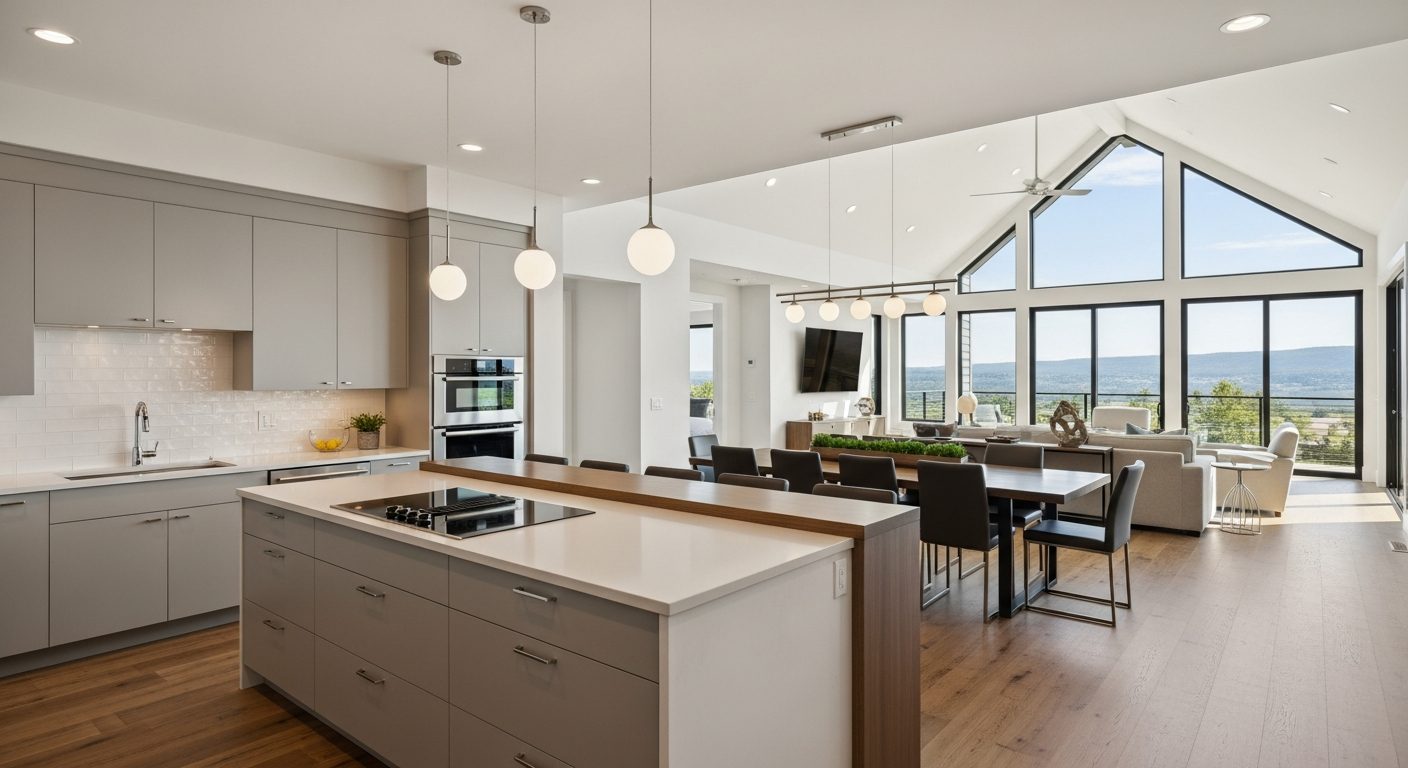
Open concept kitchens have been one of the most requested renovation projects across Kitchener-Waterloo for over a decade. The idea is simple: remove the walls separating the kitchen from the living and dining areas to create one large, connected space. When it's done well, the result is a brighter, more social home that feels significantly larger.
But an open concept kitchen renovation isn't right for every home or every family. Before you start swinging a sledgehammer, it's worth understanding the real benefits, the genuine drawbacks, and the practical considerations that will determine whether this renovation makes sense for you.
For families with young children, the ability to see the living room from the kitchen is a major advantage. You can prep dinner while watching the kids play, help with homework at the dining table while keeping an eye on the stove, or simply feel connected to your household instead of isolated in a closed-off kitchen.
Open layouts naturally encourage conversation. Guests aren't separated into different rooms — the cook stays part of the party. During holidays and gatherings, this makes a tremendous difference in how the home feels. The kitchen island often becomes the social hub, with people sitting on stools chatting while meals come together.
Removing walls allows light from windows in one area to reach the entire space. This is especially valuable in older Kitchener homes where individual rooms can feel dark and compartmentalized. A kitchen that previously had one small window over the sink can suddenly benefit from living room windows and even patio doors.
Even without adding a single square foot, an open concept renovation makes your home feel dramatically larger. The visual flow from kitchen to living to dining creates a sense of spaciousness that separate rooms simply can't match. In smaller homes — common in Waterloo's older neighbourhoods — this perceived space increase can be transformative.
Without walls dictating where things go, you gain flexibility in arranging furniture, cabinetry, and appliances. A kitchen island can define the boundary between cooking and living zones. A dining table can float in the transition area. You can reorganize as your needs change without structural work.
This is the trade-off that catches people off guard. When you're frying fish or searing steaks, those smells fill the entire living space. The clatter of dishes, the hum of the dishwasher, and the noise of the range hood become background sounds in every connected room. If someone is trying to watch television or take a phone call while you're cooking, it can be disruptive.
In a closed kitchen, you can shut the door on a pile of dirty dishes. In an open concept layout, the kitchen is visible from every angle. This means maintaining a higher standard of tidiness at all times, which can be exhausting for busy families. Counter clutter, sink messes, and general kitchen chaos are always part of the view.
Walls aren't just barriers — they hold upper cabinets, artwork, shelving, and light switches. Removing a wall between the kitchen and living room means losing a significant amount of storage. You'll need to compensate with a larger island, pantry cabinet, or creative storage solutions elsewhere.
Many walls in homes across the Kitchener-Waterloo region are load-bearing, meaning they support the structure above. Removing a load-bearing wall requires a structural engineer's assessment and the installation of a support beam (sometimes called an LVL or steel beam). This can add several thousand dollars to the project and requires a building permit from the City of Kitchener, City of Waterloo, or the relevant municipality.
Open floor plans offer limited visual and acoustic privacy. If you work from home at the dining table, you'll hear every kitchen activity. If a teenager wants to snack at midnight, the sound carries into living areas. For some households, the separation that walls provide is genuinely useful.
Before any demolition begins, you need to determine what's structural and what isn't. Here's what the process typically looks like:
A load-bearing wall supports the weight of the structure above it — the floor joists of a second storey, the roof trusses, or both. Clues include:
However, these are guidelines, not rules. Always hire a structural engineer or licensed contractor to make the determination. In the Kitchener-Waterloo area, a structural engineer's assessment for a wall removal typically costs between $500 and $1,500.
If the wall is load-bearing, it will be replaced with a beam — typically a laminated veneer lumber (LVL) beam or a steel I-beam. The beam transfers the load to posts at each end, which carry the weight down to the foundation. The beam can usually be concealed within the ceiling, though this depends on the existing ceiling height and joist direction.
Walls often contain plumbing pipes, electrical wiring, ductwork, and gas lines. Each of these needs to be rerouted before the wall comes down. This can be straightforward or complicated depending on what's inside. Your contractor should open a small section of the wall for inspection before providing a final quote.
In Ontario, removing a load-bearing wall requires a building permit. The permit process ensures the work is designed and inspected to meet the Ontario Building Code. Skipping permits to save time or money is a serious mistake — it can cause problems when you sell the home and may void your home insurance in certain situations.
An open floor plan works best when the different functional areas — cooking, eating, relaxing — are visually defined without physical barriers. Effective zone-defining strategies include:
When rooms flow together, the colour scheme needs to work as a whole. This doesn't mean everything has to match, but the kitchen cabinetry, living room paint, and dining area should share a complementary palette. Neutral perimeter cabinets with a bold island colour is a popular approach that ties both zones together.
In an open concept kitchen, proper ventilation is non-negotiable. A range hood that vents to the exterior (not a recirculating model) will dramatically reduce cooking odours in the living space. Budget for a hood that's rated for at least 400 CFM — more if you cook frequently with high heat.
Losing upper cabinets on the removed wall means you need to recapture that storage. Options include a tall pantry cabinet, a larger island with deep drawers, or a butler's pantry tucked behind the kitchen. Our team can help you explore cabinet door styles and configurations that maximize storage without overwhelming the open layout.
The cost of opening up a kitchen varies widely based on what's involved. Here's a general breakdown for the Kitchener-Waterloo area:
These are rough ranges. Your actual costs will depend on the specific conditions of your home, the materials you choose, and the extent of mechanical rerouting required. Getting multiple quotes and having a detailed scope of work before committing is essential.
Consider an open concept renovation if:
Think twice if:
An open concept kitchen renovation is a significant project, but when planned thoughtfully, it can fundamentally improve how your home looks, feels, and functions. The key is going in with realistic expectations and a solid plan.
Visit our showroom at 899 Victoria St N in Kitchener to see kitchen cabinetry, countertop options, and design ideas that work beautifully in open concept layouts. Our team has helped homeowners throughout Kitchener, Waterloo, Cambridge, and Guelph plan renovations that work for their homes and their lifestyles. Contact us or call (519) 744-2284 to start the conversation.
Answers to your renovation questions
Removing a load-bearing wall in the Kitchener-Waterloo area typically adds several thousand dollars, plus a structural engineer's assessment that usually runs $500 to $1,500. Non-load-bearing walls cost far less. The beam, posts, and permit drive the price. Because layout changes ripple into cabinetry, it's worth planning early; Kitchen & Bath World designs kitchens in 3D and offers free estimates on the cabinetry side.
Clues include a wall that runs perpendicular to the floor joists above, sits over a beam or wall in the basement, or is near the centre of the house, but these are only guidelines. Always have a structural engineer or licensed contractor confirm before any demolition. Permits and inspections in Waterloo Region depend on getting this right, as covered in our renovation permits guide.
Yes. In Ontario, removing a load-bearing wall requires a building permit, and the work must be designed and inspected to meet code. The City of Kitchener, City of Waterloo, and Cambridge each have their own process. Skipping the permit can cause problems at resale. Our Waterloo Region permits guide walks through what's required before you start an open concept project.
Compensate for lost upper cabinets with a larger island, a tall pantry cabinet, and smart interior organizers so you don't sacrifice capacity for openness. Planning storage into the new layout from day one is far easier than retrofitting later. Kitchen & Bath World designs every layout in 3D to maximize storage. For ideas, see our kitchen pantry design ideas to recover the capacity an open plan removes.
No, but the trend has softened toward "broken plan" designs that keep sightlines while adding partial walls, islands, or glass partitions for some separation. Open layouts still dominate requests across Kitchener-Waterloo for light and entertaining. The right call depends on your household's tolerance for noise and visible mess. Our 2026 design trends guide covers where open and defined spaces are heading.
The island usually becomes the social hub and the boundary between cooking and living zones, so it tends to grow larger and take on seating, storage, and sometimes the sink or cooktop. Getting its size and clearances right is critical in an open room. Kitchen & Bath World plans islands in 3D against the whole space. See our kitchen island size and layout guide for clearances and proportions.
Have more questions? We’re here to help.
Come see the cabinets and finishes in person at 899 Victoria St N, Kitchener — or fill out the form and our team will get back to you about your kitchen or bath project.